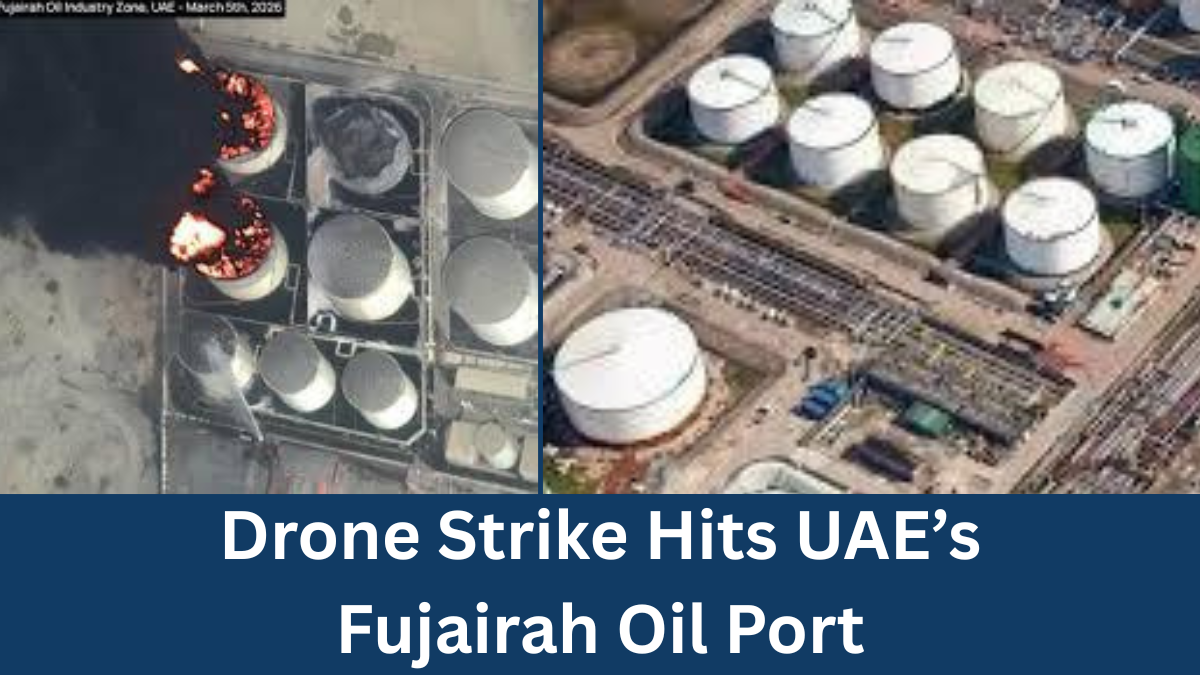
Fujairah, United Arab Emirates – March 14, 2026
Drone incident reported near Fujairah port
Authorities in the United Arab Emirates confirmed a drone-related incident near Fujairah port, one of the region’s most important energy hubs. Officials said debris from an intercepted drone caused a fire inside the port complex. Emergency teams quickly responded and contained the blaze before it spread further. The incident temporarily disrupted some operations at Fujairah port, which handles major oil storage and shipping activities.
The attack occurred during a period of heightened tension across the Middle East. Regional governments have increased security measures around energy infrastructure and shipping lanes. Military confrontations between the United States and Iran have already affected oil exports and maritime traffic. Analysts say the latest incident highlights how energy facilities have become sensitive targets during the conflict.
Why Fujairah port holds strategic importance
Fujairah port sits on the Gulf of Oman along the eastern coast of the United Arab Emirates. The location gives it a unique advantage because ships can access the port without passing through the Strait of Hormuz. This narrow waterway connects the Persian Gulf to global shipping routes and often becomes a flashpoint during regional tensions. By operating outside that choke point, the port serves as a crucial alternative for oil exports.
The facility ranks among the largest oil storage centers in the Middle East. Massive storage tanks across the port complex hold millions of barrels of crude and refined petroleum products. Energy companies use the site to store, blend, and transport fuel to international markets. Because of this scale, any disruption at the port can affect regional supply chains.
The port also functions as a major bunkering hub for international shipping. Bunkering refers to the process of refueling vessels traveling across global sea routes. Hundreds of ships stop in Fujairah every month to replenish fuel before continuing long voyages. Maritime analysts say the port’s location makes it a critical stop for vessels moving between Asia, Europe, and Africa.
Also Read – Rising tensions in Asia as Pyongyang launches multiple missiles during joint US–South Korea exercises. North Korea Fires Over 10 Ballistic Missiles During US–South Korea Drills.
Footage shows smoke rising from oil facility
Videos shared on social media showed large plumes of smoke rising from the port area after the incident. Witnesses reported seeing emergency vehicles and firefighting teams responding quickly. Authorities later confirmed that the smoke resulted from a fire triggered by falling debris. Officials stressed that the blaze remained limited and did not damage major storage tanks.
Government statements indicated that no injuries occurred during the event. Safety teams inspected nearby infrastructure to ensure no additional hazards existed. Authorities temporarily restricted certain port areas during the inspection process. The measures aimed to protect workers and maintain safe conditions across the facility.
Regional tensions linked to the attack
The incident came shortly after U.S. forces targeted Iranian energy infrastructure in recent military strikes. Those strikes reportedly included facilities linked to Iran’s oil export system. Iranian officials responded by warning that energy installations connected to U.S. interests could face retaliation. The warning raised concerns across Gulf states that host energy infrastructure.
Iran’s Islamic Revolutionary Guard Corps later issued statements referencing potential targets in the region. Officials said ports, military facilities, and logistics hubs connected to American interests could become legitimate targets. The statements followed the reported U.S. attack on Kharg Island, which plays a central role in Iran’s oil exports. Energy analysts say such exchanges often heighten fears about broader disruption to global oil supplies.
Oil operations adjusted after Fujairah port incident
Following the drone incident, some loading operations at the port were temporarily suspended. Authorities paused several shipping activities while investigators assessed the situation. Officials did not disclose the exact scale of the suspension but said most operations continued normally. Security teams also reviewed surveillance footage and monitoring systems around the facility.
The Abu Dhabi National Oil Company, commonly known as Abu Dhabi National Oil Company, reportedly adjusted crude supply volumes for some partners this month. Energy officials reduced certain shipments by roughly twenty percent as a precaution. The adjustment aims to stabilize supply flows while infrastructure checks continue. Industry sources say such measures help maintain operational safety during security incidents.
Energy markets reacted cautiously to the reports from the UAE. Oil traders monitored the situation closely because Fujairah serves as a major storage and shipping center. Even limited disruptions can affect pricing expectations in global markets. However, analysts said the quick containment of the fire prevented a major supply shock.
Shipping concerns grow across Gulf region
The broader conflict has already disrupted maritime activity across the Gulf region. The Strait of Hormuz remains one of the world’s most critical oil transit routes. Nearly one fifth of global oil shipments normally pass through the narrow channel. Security threats and military operations have significantly reduced traffic through the strait in recent weeks.
Because of those risks, alternative shipping hubs such as Fujairah have gained greater importance. Tankers increasingly rely on ports located outside the strait to avoid potential dangers. Industry experts say these alternative routes help stabilize global energy trade during periods of instability. The drone incident therefore raised concerns among shipping companies monitoring the conflict.
Maritime security agencies have urged vessels to maintain heightened vigilance in the region. Shipping firms often rely on real-time intelligence reports to navigate safely. Many companies also coordinate with naval patrols operating in international waters. These measures aim to reduce risks while maintaining the flow of global trade.
Security review underway at Fujairah port
Authorities in the United Arab Emirates launched a security review following the incident. Investigators are examining radar data, drone interception systems, and port surveillance records. Officials want to determine the drone’s origin and the sequence of events that led to the fire. The investigation also includes cooperation with regional security partners.
Security experts say modern energy infrastructure increasingly faces drone-related risks. Small unmanned aircraft can travel long distances and bypass traditional detection systems. Many governments have begun investing heavily in counter-drone technology to protect sensitive sites. Ports, refineries, and storage terminals rank among the most closely guarded facilities.
The UAE has previously strengthened protective measures around key energy infrastructure. These measures include surveillance networks, air defense systems, and maritime patrols. Officials say these defenses help detect and intercept threats before they cause significant damage. The quick response during the recent incident demonstrated the importance of those systems.
What comes next after the Fujairah port incident
Officials expect most operations at the port to resume fully after safety inspections conclude. Engineers continue examining storage tanks, pipelines, and loading equipment for potential damage. Early assessments suggest the facility remains structurally secure. Authorities say the port will maintain enhanced security monitoring in the coming days.
Regional governments are also watching closely for any further escalation linked to the conflict. Energy infrastructure remains particularly sensitive during periods of geopolitical tension. Markets often react quickly to news affecting oil transportation and storage. Any prolonged disruption could influence global supply chains and energy prices.
For now, the UAE government emphasizes that the incident caused limited disruption and no casualties. Officials continue coordinating with international partners to monitor regional security developments. As tensions persist across the Middle East, protecting critical energy hubs like Fujairah will remain a central priority for authorities.