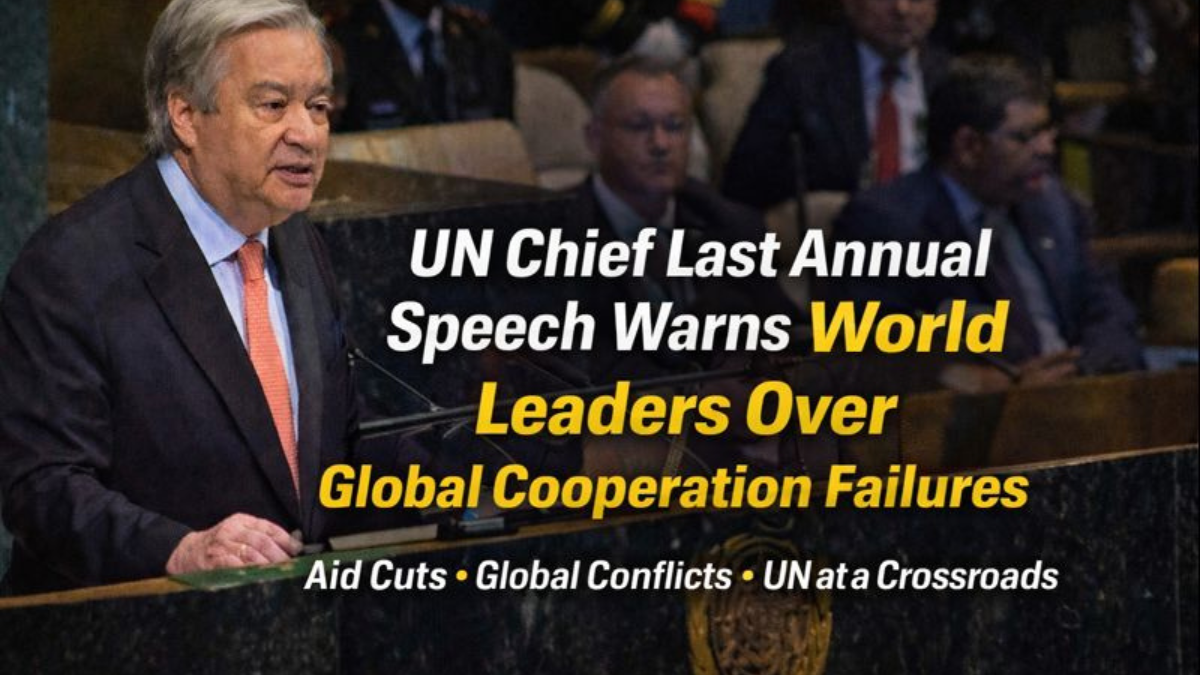
In his final annual address, UN Secretary-General António Guterres sharply criticized world leaders for abandoning cooperation amid wars, aid cuts, and geopolitical divides. Speaking in New York, he warned that global institutions face an existential test at a moment of escalating crises.
New York City, United States, 16 January, 2026
What Happened at the UN General Assembly
The UN chief last annual speech delivered by Secretary-General António Guterres struck a stark and urgent tone as he addressed world leaders gathered at the United Nations General Assembly in New York. In what will be his final annual address before stepping down in 2026, Guterres accused governments of turning away from cooperation at a time when the world desperately needs it.
Standing before diplomats from nearly every nation, Guterres warned that widening geopolitical divisions, deep funding cuts, and repeated violations of international law are pushing the global system toward breakdown. He described the moment as a stress test for multilateralism itself.
“At a time when international cooperation is needed most, we appear least willing to invest in it,” Guterres said, cautioning that some governments are actively placing global cooperation “on deathwatch.”
UN Chief Last Annual Speech Highlights Aid Cuts
A central focus of the UN chief last annual speech was the sharp reduction in humanitarian and development funding by major donor nations. Guterres warned that large-scale aid cuts are undermining life-saving operations across conflict zones and fragile regions.
While he avoided naming specific countries, his remarks appeared to reference the United States, which recently slashed its humanitarian funding commitments. Washington announced it would allocate roughly $2 billion to UN humanitarian assistance, a dramatic reduction from previous contributions that reached as high as $17 billion annually.
Guterres criticized the broader trend of wealthy nations retreating from global responsibility, saying such decisions weaken international institutions and leave millions vulnerable.
US Policy Casts a Long Shadow
The UN chief last annual speech also appeared to take aim at the “America First” policies associated with former US President Donald Trump. Under those policies, the United States dismantled key foreign aid mechanisms, including major elements of the US Agency for International Development (USAID).
UN agencies were told to “adapt, shrink, or die,” a message Guterres indirectly echoed when he warned that forcing multilateral institutions to operate without resources would accelerate global instability rather than contain it.
Although other nations have also reduced funding, the US pullback carries outsized consequences due to its historical role as the UN’s largest donor.
Global Conflicts Dominate the Final Agenda
The UN chief last annual speech outlined Guterres’s priorities for his final year in office, placing global conflicts at the center of his agenda. He reaffirmed the UN’s commitment to peace efforts in Gaza, Ukraine, Sudan, and other conflict zones.
Guterres called for humanitarian access to be allowed into Gaza without obstruction, stressing that civilians must never be used as leverage in war. He urged renewed diplomatic efforts to end the Russia-Ukraine conflict and warned that prolonged fighting risks destabilizing entire regions.
In Sudan, he pushed for renewed ceasefire talks and emphasized the urgent need for aid delivery amid one of the world’s fastest-growing humanitarian crises.
Why the Speech Matters Now
The UN chief last annual speech matters because it reflects a rare moment of candor from the world’s top diplomat at a time when the international system is visibly strained. With wars expanding, alliances fragmenting, and trust eroding, Guterres framed the current moment as a crossroads.
Critics have long argued that the UN has struggled to prevent or resolve major conflicts during Guterres’s tenure. He acknowledged these frustrations indirectly, pointing to structural limitations rather than a lack of effort.
“The UN remains tireless in delivering life-saving aid,” he said, while warning that political paralysis threatens to undo that work.
Security Council Paralysis Undermines Action
A key obstacle highlighted during the UN chief last annual speech was the paralysis of the UN Security Council. Deep divisions among its five permanent members — the United States, Russia, China, the United Kingdom, and France — have repeatedly blocked decisive action.
Veto power has prevented resolutions on Ukraine, Gaza, and other flashpoints, leaving the UN unable to act decisively even as civilian suffering escalates.
Guterres suggested that without reform or renewed political will, the Security Council risks losing credibility as the world’s primary peacekeeping body.
UN Chief Last Annual Speech Signals Legacy Moment
As Guterres prepares to leave office in 2026, the UN chief last annual speech functioned as both a warning and a legacy statement. His address reflected frustration but also urgency, emphasizing that the tools for cooperation still exist — if leaders choose to use them.
He framed the coming year as decisive, urging nations to recommit to diplomacy, humanitarian principles, and international law.
“This organization was created to save humanity from itself,” Guterres said, reminding delegates of the UN’s founding mission.
What Happens Next
Following the UN chief last annual speech, attention will turn to whether major donor nations reconsider funding decisions and whether diplomatic momentum builds around stalled peace talks.
Humanitarian agencies face difficult months ahead as budgets tighten and needs rise. Meanwhile, discussions around Security Council reform are expected to intensify, though meaningful change remains politically difficult.
Guterres is expected to spend his final year pressing for conflict de-escalation and humanitarian access, even as global divisions persist.
Conclusion
The UN chief last annual speech delivered a stark message: global cooperation is weakening at the worst possible moment. António Guterres used his final address to confront world leaders with the consequences of inaction, warning that retreating from multilateralism will only deepen instability.
Whether his warning sparks renewed commitment or fades into diplomatic rhetoric will define not just the end of his tenure, but the future credibility of the United Nations itself.
More related stories
Insurrection Act Warning as Trump Threatens Action in Minnesota
Trump Tells Iranians Help Is on Its Way Amid Growing Protests