BRUSSELS | July 11, 2026
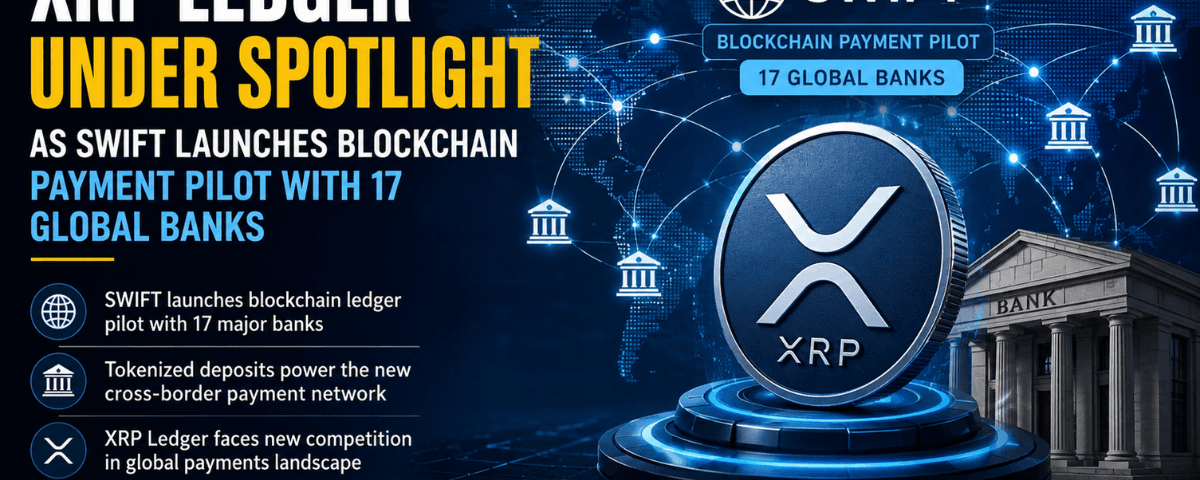
The XRP Ledger has returned to the center of discussion after SWIFT officially launched a live pilot of its blockchain-based shared ledger for tokenized cross-border payments. The initiative brings together 17 leading international banks, including HSBC, Citi, UBS, BNP Paribas, Wells Fargo, Standard Chartered, and BNY, allowing participating institutions to transfer tokenized deposits around the clock while continuing to settle transactions through existing banking infrastructure.
According to SWIFT, the new platform extends traditional financial systems into the growing digital asset ecosystem without requiring public blockchain networks or cryptocurrencies. The development has prompted renewed debate among investors and analysts over whether the XRP Ledger’s long-term value proposition could face increasing competition from modernized banking infrastructure.
SWIFT Introduces Blockchain Infrastructure for Global Banks
The Belgium-based financial messaging cooperative designed the shared ledger to support continuous movement of tokenized bank deposits, including weekends and overnight periods when traditional payment systems often experience delays.
Unlike public blockchain networks, the ledger functions as an orchestration layer connecting participating financial institutions while maintaining existing compliance, risk management, and settlement procedures already trusted by global banks.
SWIFT said the project was developed within nine months following extensive consultation with international financial institutions. The initial pilot is expected to help banks evaluate programmable payments, digital money applications, and future tokenized financial services before broader commercial deployment.
The organization serves more than 11,500 financial institutions across over 200 countries and territories, making any technological upgrade particularly significant for the future of international payments.
Why the XRP Ledger Is Part of the Discussion
The announcement immediately attracted attention because the XRP Ledger has long been promoted as an efficient solution for international money transfers.
Ripple’s payment ecosystem enables financial institutions to settle transactions using its On-Demand Liquidity (ODL) service, where XRP can function as a bridge asset between different currencies. The technology aims to reduce settlement times and lower liquidity costs for banks and payment providers.
However, SWIFT’s new ledger follows a different model. Rather than relying on a cryptocurrency, participating institutions transfer tokenized bank deposits while final settlement continues through existing financial infrastructure. This allows banks to modernize payment operations without fundamentally changing their regulatory or operational framework.
Some market analysts argue that this approach could reduce the incentive for banks to adopt blockchain networks requiring digital assets for settlement.
Ripple Still Maintains Important Institutional Advantages
Despite concerns, the launch does not necessarily eliminate opportunities for Ripple or the XRP Ledger.
Several institutions participating in SWIFT’s pilot have existing relationships with Ripple or have previously explored blockchain-based payment technologies. Industry observers note that many financial institutions increasingly pursue multiple payment technologies simultaneously rather than committing to a single infrastructure.
Ripple has also continued expanding its regulatory footprint during the past year, securing licenses across multiple jurisdictions while strengthening partnerships with financial institutions seeking compliant digital payment solutions.
Supporters of Ripple argue that SWIFT’s messaging infrastructure and Ripple’s settlement technology are not mutually exclusive. In certain payment corridors, banks could potentially use SWIFT for messaging while choosing Ripple’s liquidity services when those provide operational or cost advantages.
This possibility means future adoption decisions are likely to depend less on technology headlines and more on measurable improvements in efficiency, transaction costs, and liquidity management.
Institutional Adoption Will Determine the Next Phase
The current debate ultimately centers on adoption rather than technology alone.
SWIFT’s pilot demonstrates that traditional financial institutions are increasingly embracing tokenization and blockchain-inspired infrastructure without abandoning existing banking systems. At the same time, Ripple continues positioning the XRP Ledger as an interoperable solution capable of supporting global liquidity across multiple payment networks.
As both initiatives continue developing, banks will evaluate which infrastructure best meets regulatory requirements, operational efficiency, customer demand, and cross-border settlement costs.
Rather than producing an immediate winner, the latest development signals that international payments are entering a period where multiple technologies may coexist, each serving different institutional needs.
XRP Market Reaction Remains Measured
Financial markets responded cautiously following SWIFT’s announcement. While XRP recorded modest price gains immediately after the news, institutional investment data suggested that professional investors remained careful about increasing exposure.
Recent trading activity showed mixed sentiment, with buyers attempting to push XRP higher while some institutional funds reduced positions. This divergence indicates that investors are waiting for stronger evidence that increased blockchain adoption by banks will directly translate into greater demand for XRP.
From a technical perspective, traders continue watching important resistance levels that could determine whether XRP builds sustained upward momentum or enters another period of consolidation. Although momentum indicators remain positive, buying pressure has moderated compared with earlier sessions, suggesting that market participants are seeking additional catalysts before committing to larger positions.
The Real Test Lies in Bank Adoption
The long-term impact of SWIFT’s blockchain initiative will depend less on technology announcements and more on how banks choose to settle transactions once commercial deployments begin.
SWIFT’s shared ledger is designed to remain neutral, allowing financial institutions to move tokenized deposits without requiring public blockchain assets. However, it does not prevent banks from integrating external liquidity providers where doing so improves speed, cost efficiency, or foreign exchange settlement.
Industry analysts believe the next phase will become clearer when banks begin expanding tokenized payment corridors beyond pilot programs. If financial institutions determine that Ripple’s On-Demand Liquidity offers measurable cost savings in certain regions, the XRP Ledger could continue playing a complementary role rather than competing directly with SWIFT.
Conversely, if banks achieve similar efficiency through tokenized deposits operating entirely within SWIFT’s ecosystem, the incentive to adopt bridge assets may become less compelling. The outcome will ultimately be driven by commercial performance rather than theoretical advantages.
Stellar Faces Similar Questions in Tokenized Finance
The debate surrounding the XRP Ledger also extends to Stellar, another blockchain platform focused on fast and low-cost international payments.
Like Ripple, Stellar is not integrated into SWIFT’s newly launched ledger. As a result, the same competitive questions apply. If traditional banks successfully process tokenized payments using their own infrastructure, public blockchain networks may face increased pressure to demonstrate unique advantages that cannot easily be replicated by conventional financial institutions.
Nevertheless, Stellar continues to expand its institutional presence. The network has seen growth in tokenized assets, stablecoin activity, and payment volumes while maintaining extremely low transaction fees and high network reliability. Major financial organizations have also selected Stellar for various tokenization initiatives, reinforcing confidence in its technology.
Even so, broader adoption does not automatically translate into stronger demand for native digital assets. As with XRP, institutions can benefit from blockchain infrastructure without necessarily creating proportional buying pressure for the underlying token.
Digital Payments Are Entering a Multi-Network Era
SWIFT’s latest initiative reflects a broader transformation occurring across global finance. Banks are increasingly exploring tokenized deposits, digital assets, programmable payments, and blockchain infrastructure while seeking to preserve regulatory compliance and operational stability.
Instead of replacing existing payment systems overnight, many institutions are building interoperable networks capable of supporting multiple settlement methods. This approach reduces operational risk while allowing gradual adoption of emerging technologies.
For Ripple, the challenge is no longer proving that blockchain can improve international payments. The focus has shifted toward demonstrating that the XRP Ledger delivers measurable economic advantages beyond what traditional banking infrastructure can achieve independently.
As tokenized finance continues expanding, competition between established financial institutions and blockchain-native payment networks is expected to intensify. The winners will likely be those capable of combining regulatory certainty, operational efficiency, liquidity management, and global scalability.
Whether the XRP Ledger becomes an essential component of that future will depend on practical adoption by banks rather than market speculation. SWIFT’s blockchain pilot marks an important milestone in digital finance, but the broader evolution of cross-border payments is still unfolding.
FAQ
What is the XRP Ledger?
The XRP Ledger is a decentralized blockchain designed to facilitate fast and low-cost cross-border payments. It supports Ripple’s payment ecosystem and can serve as a bridge between different currencies during international transactions.
Does SWIFT’s blockchain ledger replace XRP?
No. SWIFT’s shared ledger operates using tokenized bank deposits and existing banking infrastructure. While it does not require XRP, it also does not prevent banks from using Ripple’s payment solutions if they offer operational or economic advantages.
Why are investors closely watching SWIFT’s pilot?
The pilot involves major global banks and could influence how future cross-border payments are processed. Its success may shape institutional adoption of tokenized finance and determine whether blockchain networks like the XRP Ledger gain or lose relevance in commercial banking.
Topic Coverage
Explore our analysis of how global financial policy continues to influence international markets in our coverage of Trump’s dollar policy.
Read our report on Turkey’s Typhoon fighter agreement to understand how geopolitical developments increasingly intersect with technology, trade, and international finance.
Source:
Reuters, SWIFT Official Statement, Ripple public announcements.