WASHINGTON, D.C. – July 21, 2026
Pentagon Warns Military Readiness Could Decline Without Emergency Funding
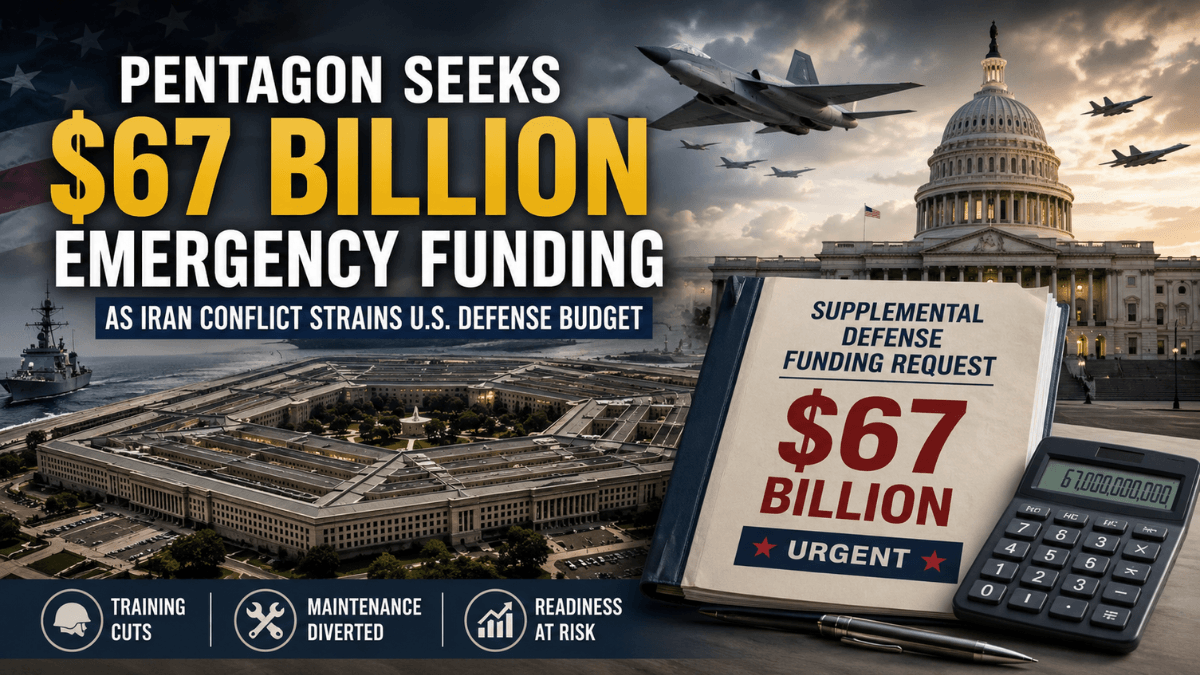
The Pentagon is urging Congress to approve a 67 billion military funding request as the cost of the ongoing conflict with Iran continues to place unexpected pressure on the U.S. defense budget. According to U.S. officials, several military funding accounts could be depleted within weeks, forcing the Department of Defense to scale back activities that are considered essential for maintaining combat readiness.
Defense Secretary Pete Hegseth is scheduled to testify before the Senate Appropriations Committee alongside Chairman of the Joint Chiefs of Staff Gen. Dan Caine, where both are expected to explain why emergency funding is needed before current operational accounts are exhausted. The hearing represents the administration’s most significant effort so far to persuade lawmakers that additional military spending cannot be delayed.
According to government officials, the White House has asked Congress to approve a supplemental defense package worth $67 billion to cover operational costs generated by the expanding conflict. The request comes as negotiations on Capitol Hill remain stalled, creating uncertainty over whether lawmakers can reach an agreement before the House of Representatives begins its scheduled recess.
The funding debate extends beyond immediate military spending. Pentagon officials argue that delays could affect force readiness, military modernization, equipment maintenance, and training schedules that support both current operations and future contingencies.
Congress Faces Pressure as Pentagon Spending Accelerates
According to current and former U.S. officials, financial pressures are already producing operational consequences inside the Defense Department. Military exercises have reportedly been reduced or postponed, while training programs designed to prepare service members for future deployments are facing funding constraints.
Maintenance budgets have also become a growing concern. Resources originally intended for repairing military equipment, maintaining installations, and supporting long-term readiness are increasingly being redirected toward sustaining active combat operations in the Middle East.
Defense planners have warned lawmakers that these temporary adjustments cannot continue indefinitely without affecting overall military capability. Readiness programs are designed to ensure forces remain prepared for a wide range of global missions, and prolonged reductions could create challenges extending well beyond the current conflict.
The Pentagon has reportedly informed Congress that additional difficult budget decisions may become unavoidable if emergency appropriations are not approved in the coming weeks.
Collapse of Iran Ceasefire Increased Financial Demands
Budget pressure intensified after the collapse of the ceasefire between the United States and Iran. Renewed fighting followed the deaths of four U.S. service members during more than a week of escalating hostilities, prompting Washington to prepare for the possibility of a broader regional conflict.
President Donald Trump authorized U.S. air operations against Iran in late February with the expectation that military action would conclude relatively quickly. Instead, combat operations have continued for several months, significantly increasing operational expenses across multiple branches of the U.S. military.
The extended campaign has required sustained deployments of aircraft, naval vessels, missile defense systems, logistics assets, intelligence capabilities, and thousands of military personnel throughout the Middle East. Such long-duration operations typically consume billions of dollars beyond normal annual defense planning because they involve continuous fuel consumption, precision-guided munitions, maintenance, transportation, and troop support.
The conflict has also produced wider economic consequences beyond defense spending. Iran’s closure of the Strait of Hormuz disrupted one of the world’s most strategically important maritime routes for oil and fertilizer exports, creating uncertainty in global energy markets and increasing concerns about international supply chains.
Beyond the immediate military costs, analysts note that prolonged regional instability often affects defense procurement schedules, alliance planning, and global security commitments. As operational demands continue, Pentagon officials argue that maintaining readiness across multiple theaters requires stable congressional funding rather than temporary financial adjustments.
Pentagon Shifts Funds While Awaiting Congressional Action
To keep military operations running until the next fiscal year begins on October 1, the Pentagon has started moving money between existing accounts. According to government officials, the Defense Department has requested congressional approval to reallocate approximately $4.3 billion from military training programs and planned weapons procurement toward immediate operational requirements.
The proposed transfer reflects the difficult financial choices defense leaders face as combat operations continue. Redirecting funds may help sustain current missions, but it could delay modernization efforts, procurement schedules, and training activities that are essential for maintaining long-term military effectiveness.
The White House Office of Management and Budget is also exploring options to strengthen the Pentagon’s operations and maintenance accounts. According to administration officials, additional transfers could be made from other federal programs, although no agencies or programs have been publicly identified. Such reallocations typically require careful budget reviews and, in some cases, congressional approval.
Defense budget experts note that transferring money between accounts is often used as a temporary measure during emergencies. However, these adjustments cannot permanently replace supplemental appropriations when military operations continue longer than originally anticipated.
Navy and Air Force Face Growing Operational Pressure
The prolonged conflict has placed significant demands on the U.S. Navy and Air Force, both of which have expanded their presence across the Middle East since hostilities intensified. Additional aircraft carriers, warships, fighter aircraft, surveillance platforms, and support personnel have been deployed to protect regional interests and sustain ongoing military operations.
According to congressional aides, operational funding allocated to the Navy and Air Force for fiscal year 2026 is expected to be exhausted before the current month ends unless additional appropriations are approved.
Military analysts say sustained overseas deployments create expenses that extend well beyond combat operations. Fuel consumption, aircraft maintenance, naval logistics, ammunition replenishment, equipment repairs, transportation, intelligence support, and personnel rotations all contribute to rapidly rising operational costs.
The Pentagon also faces the challenge of maintaining global readiness while concentrating substantial military resources in one region. U.S. forces continue to support commitments in Europe, the Indo-Pacific, and other strategic areas, making stable funding increasingly important as international security challenges evolve.
Competing Funding Plans Highlight Political Divide
The administration’s request for a $67 billion military funding request has become part of a broader debate on Capitol Hill over defense spending priorities.
While the White House is seeking immediate supplemental funding through Congress, House Republicans are simultaneously advancing a separate budget reconciliation proposal that would authorize approximately $73 billion in additional defense spending. Because reconciliation legislation requires only a simple majority in the Senate, supporters argue that it could provide a faster legislative path than traditional appropriations.
Representative Pat Harrigan, a member of the House Armed Services Committee, cautioned that lawmakers should not underestimate the Pentagon’s financial situation, arguing that greater urgency is needed to address the military’s operational requirements.
Initially, Pentagon officials declined to comment publicly on reports describing the growing budget pressures. Following widespread media attention, Pentagon Press Secretary Sean Parnell stated that Defense Secretary Pete Hegseth would “do whatever is necessary” to preserve military readiness, emphasizing that national defense remains a top administration priority.
Separately, White House Budget Director Russell Vought is expected to continue briefing Republican lawmakers as the administration works to build support for the supplemental defense package.
Why the Funding Debate Matters
The debate over the 67 billion military funding request extends beyond immediate battlefield expenses. Defense officials argue that delayed funding decisions could affect military preparedness, equipment maintenance, procurement programs, and service member training for months after the current conflict subsides.
Military readiness depends on consistent investment across every branch of the armed forces. While emergency fund transfers may temporarily support ongoing operations, prolonged uncertainty could slow modernization efforts, delay weapons acquisition, and reduce training opportunities that prepare personnel for future missions.
The funding discussion also carries broader geopolitical implications. Continued instability in the Middle East has affected global energy markets, maritime trade routes, and security planning among U.S. allies. As long as military operations continue, Congress will likely face continued pressure to balance fiscal priorities with national security requirements.
The Senate hearing involving Defense Secretary Pete Hegseth and Gen. Dan Caine is expected to provide lawmakers with updated assessments of operational needs and funding requirements. Congressional decisions in the coming weeks will play a central role in determining how the Pentagon manages military readiness while supporting ongoing operations abroad.
FAQ
Why is the Pentagon requesting a $67 billion military funding request?
The White House has requested the supplemental funding to cover rising operational costs associated with the ongoing Iran conflict. Defense officials say existing military accounts are being depleted faster than expected due to sustained deployments and combat operations.
How is the Pentagon managing the funding shortfall?
The Defense Department has sought approval to reallocate $4.3 billion from training programs and planned weapons purchases to support immediate operational needs. Officials are also reviewing other budget transfer options while awaiting congressional action.
What could happen if Congress delays approving new funding?
Defense officials warn that continued delays could result in additional reductions to military training, equipment maintenance, procurement programs, and overall readiness. Temporary fund transfers may help in the short term but are not viewed as a long-term solution for sustaining military operations.
Topic Coverage
The Pentagon’s 67 billion military funding request reflects mounting financial pressure from the ongoing Iran conflict. Congress is weighing emergency defense appropriations as military readiness, training programs, and operations face growing budget constraints.
Source
According to current and former U.S. officials, statements from the U.S. Department of Defense, the White House Office of Management and Budget, and congressional officials.
Learn More About U.S. Department of Defense – https://www.defense.gov/