WASHINGTON, D.C. – July 22, 2026
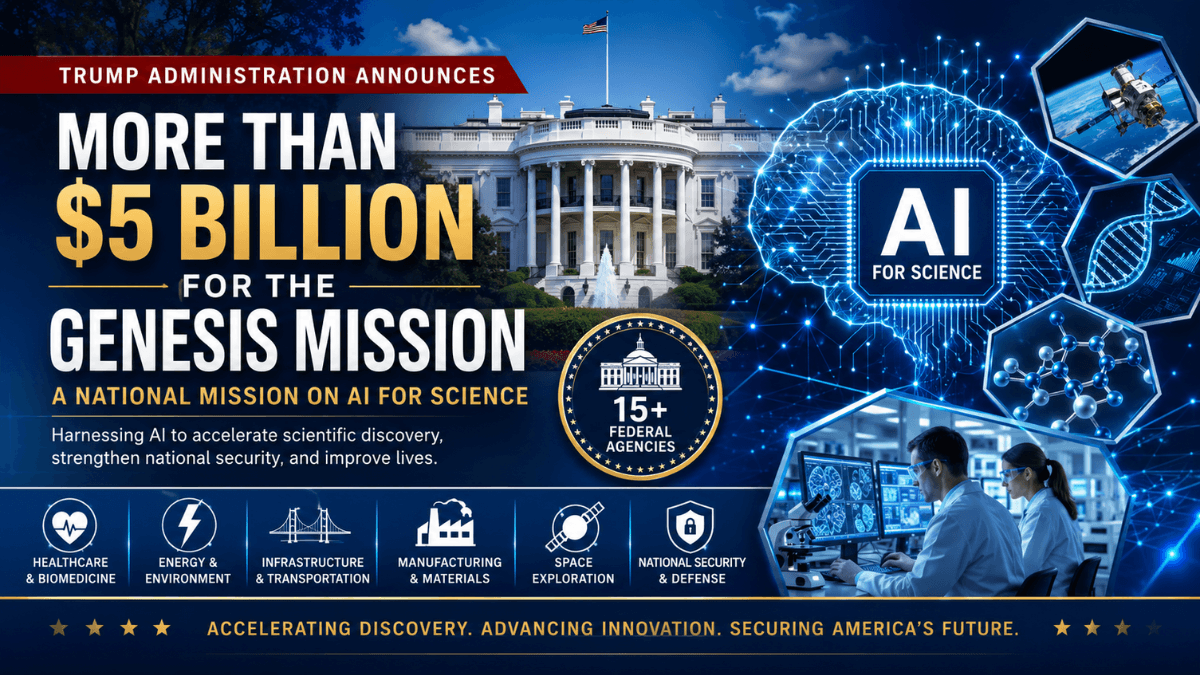
The Trump administration has announced more than $5 billion in new federal commitments to expand the Genesis Mission AI for Science, a nationwide initiative designed to accelerate scientific discovery using artificial intelligence. Unveiled by White House Office of Science and Technology Policy Director Michael Kratsios, the initiative brings together more than 15 federal agencies to support mission-driven research through funding opportunities, scientific datasets, computing resources, and specialized research facilities. According to the White House, the expanded program aims to strengthen U.S. leadership in AI-powered scientific innovation across multiple disciplines.
Genesis Mission AI for Science expands into a whole-of-government initiative
Originally launched through President Donald Trump’s Executive Order in November 2025, the Genesis Mission has evolved from a Department of Energy initiative into a coordinated federal effort involving agencies across healthcare, energy, transportation, agriculture, space exploration, and national security.
At the center of the initiative is the American Science and Security Platform, a Department of Energy-developed infrastructure that connects researchers with high-performance computing, scientific datasets, and advanced AI tools. Federal officials say this shared platform will enable researchers to solve complex scientific problems more efficiently while encouraging collaboration across government institutions.
Michael Kratsios described the initiative as the next phase of America’s tradition of national scientific mobilization. He said the Genesis Mission is intended to combine artificial intelligence with the country’s scientific capabilities on a scale unmatched by other nations, creating new opportunities for breakthrough discoveries.
More than 15 federal agencies will support AI-driven research
The expanded Genesis Mission includes participation from agencies including the Department of Energy, Department of Health and Human Services, NASA, National Science Foundation, Department of Transportation, Department of the Interior, Department of Agriculture, National Institute of Standards and Technology, and several others.
Officials said participating agencies will contribute research grants, specialized scientific data, national laboratory resources, and computing infrastructure to support newly announced National Science and Technology Challenges. These collaborative projects are designed to apply artificial intelligence to complex scientific questions that would be difficult for a single agency to address independently.
Energy Secretary Chris Wright said the initiative selected 278 research projects, reflecting strong interest from the U.S. scientific community. According to Wright, the number and quality of proposals demonstrate both the strength of America’s research ecosystem and the potential for further expansion of the Genesis Mission in future funding rounds.
National challenges target healthcare, energy, infrastructure and scientific discovery
The Genesis Mission’s newly announced National Science and Technology Challenges focus on using artificial intelligence to accelerate breakthroughs in areas with broad public and economic impact.
In healthcare, participating agencies plan to combine secure health records, genomic data, environmental information, and advanced computing to identify the root causes of chronic diseases, improve pediatric cancer research, accelerate drug discovery, and enhance preventive healthcare for military veterans. Federal officials said these efforts are intended to shorten the time between scientific research and real-world medical treatments.
The initiative also aims to modernize critical infrastructure and strengthen energy systems. Planned projects include developing AI-powered digital twins for transportation networks and buildings, improving electricity grid planning, and applying artificial intelligence to manage natural resources more efficiently. Officials believe these technologies could lower costs while increasing the resilience of national infrastructure.
Manufacturing and industrial innovation represent another major focus. The Department of Energy and partner agencies will use AI to advance semiconductor research, improve biological manufacturing, accelerate weapons component design, and support domestic production of fuels, chemicals, and advanced materials. These projects are expected to strengthen U.S. industrial competitiveness while supporting national security priorities.
AI will support space research, quantum computing and national security
Federal agencies also outlined plans to apply artificial intelligence to some of the country’s most advanced scientific research programs.
NASA and the Department of Energy will use AI to analyze more than 150 petabytes of scientific data collected from satellites, telescopes, orbiters, and space missions. Researchers hope the approach will accelerate discoveries in astronomy, Earth science, astrophysics, and biological sciences. Other projects include developing autonomous laboratories that combine robotics with AI, advancing quantum computing technologies, designing new materials, and improving biological modeling.
The initiative also includes national security applications. Agencies plan to deploy AI for earlier detection of biological threats, automate materials testing for the nuclear security enterprise, and strengthen forensic analysis of nuclear materials through machine learning. Officials say these capabilities are intended to improve preparedness against emerging threats while maintaining America’s technological leadership.
The Genesis Mission also aligns with the Trump administration’s broader strategy of strengthening America’s scientific and defense capabilities through increased federal investment. The announcement follows other major funding initiatives, including the administration’s push for a $67 billion military funding request aimed at sustaining U.S. military readiness and supporting ongoing operations as geopolitical tensions continue to influence defense priorities. Together, these investments reflect a wider effort to enhance both national security and technological leadership. Read more about the $67 billion military funding request.
Why the Genesis Mission matters
According to the White House, the Genesis Mission is designed to transform how scientific research is conducted by combining government datasets, high-performance computing, and artificial intelligence into a unified research platform. Officials believe this collaborative approach can accelerate discoveries that would be difficult for individual agencies to achieve independently.
The administration also said the initiative reflects broader efforts to modernize America’s research enterprise by expanding access to world-class computing infrastructure and encouraging greater collaboration among federal agencies, universities, national laboratories, and research institutions. Additional announcements involving industry, philanthropic organizations, and international partnerships are expected as the Genesis Mission continues to expand.
FAQ
What is the Genesis Mission AI for Science?
The Genesis Mission AI for Science is a U.S. government initiative launched to accelerate scientific discovery using artificial intelligence. It combines federal research funding, scientific datasets, supercomputing resources, and AI tools across multiple agencies.
How much funding was announced for the Genesis Mission?
The Trump administration announced more than $5 billion in federal commitments to expand the Genesis Mission. The funding supports research awards, computing infrastructure, scientific datasets, and National Science and Technology Challenges across more than 15 federal agencies.
Which sectors will benefit from the Genesis Mission?
The initiative supports projects in healthcare, energy, transportation, manufacturing, agriculture, space exploration, quantum computing, and national security, with AI serving as the primary tool to accelerate research and innovation.
Topic Coverage
The Trump administration has committed more than $5 billion to expand the Genesis Mission AI for Science, creating a whole-of-government initiative that uses artificial intelligence to accelerate research across healthcare, energy, manufacturing, infrastructure, and national security.
The initiative brings together more than 15 federal agencies, leveraging shared AI infrastructure, scientific datasets, and supercomputing resources to advance research, strengthen U.S. technological leadership, and accelerate scientific discoveries.
Source
White House Office of Science and Technology Policy (OSTP)
Learn More about : Office of Science and Technology Policy (OSTP)